Philips Air Purifier Smart 600i Series vs Philips Air Purifier 600 Series
We compare the Philips Air Purifier Smart 600i Series and the Philips Air Purifier 600 Series across every dimension that matters - our scores, the key specs, and how each performs on the things you will actually notice day to day.

At a glance
| Philips Air Purifier Smart 600i Series | Philips Air Purifier 600 Series | |
|---|---|---|
| Our score | 8.0/10 | 7.9/10 |
| Best for | Medium to large rooms up to 44 m² with allergy, dust and odour concerns | Medium to large rooms up to 44 m² with allergy, dust and odour concerns |
| Not ideal for | Buyers on the tightest budget | Buyers on the tightest budget |
| Brand | Philips | Philips |
Specifications compared
| Philips Air Purifier Smart 600i Series | Philips Air Purifier 600 Series | |
|---|---|---|
| CADR | 170 m³/h | 170 m³/h Max air cleaning |
| Sleep noise | 19 dB(A) | 19 dB Sleep mode |
Design and Build Quality
Philips Air Purifier Smart 600i Series
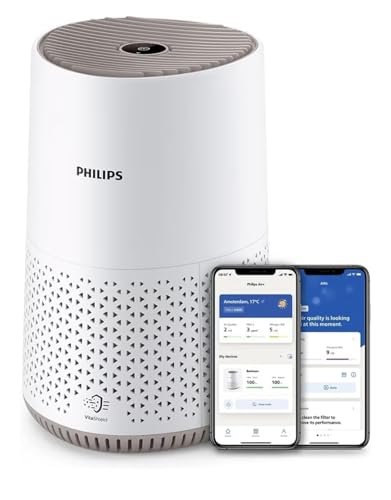
This air purifier/10 Smart 600i has a compact, slim housing designed to fit into smaller spaces, with dimensions of 24.3 x 23.7 x 34.1 cm (D x W x H) and a weight of 2.2 kg. In this review, the build appears straightforward and sturdy, with a white finish intended to suit most rooms. The digital display includes a dimmable light, which helps during bedtime. Setup is simple, and the light footprint makes it easier to place on shelves or floors. The narrow body may, however, limit desk-height placement options in tighter layouts.
Philips Air Purifier 600 Series
A compact, upright housing helps this air purifier/10 fit into typical UK rooms, with dimensions of 24.3 (D) x 23.7 (W) x 34.1 (H) cm and a weight of 2.2 kg. The air purifier uses a white, silk beige finish designed to remain visually discreet. Build quality feels solid, with a digital display and controls built into the front panel for quick status checks. The unit is straightforward to position near desks or sideboards, while leaving clear space around it to support airflow. Overall, the design prioritises simplicity over rugged styling.
CADR and Room Coverage
Philips Air Purifier Smart 600i Series
CADR and room coverage are central to how well the Philips/10 Smart 600i can clean a space. It is rated for rooms up to 44 m² with a CADR of 170 m³/h. That CADR indicates the purifier can exchange around 170 cubic metres of air each hour, which supports faster cleaning when pollutants are airborne. The 44 m² limit also signals weaker suitability for larger open-plan areas, where more units may be needed.
Philips Air Purifier 600 Series
With a CADR of 170 m³/h, the Philips/10 is designed to clean rooms up to 44 m², which makes it suitable for many UK bedrooms and living spaces. This coverage is relevant because higher airflow can cycle room air more quickly, particularly in open layouts. The manufacturer states the unit can purify a room in under 17 minutes, and it targets pollutants including PM2.5, pollen and pet dander. Results vary with room height, airflow patterns and how consistently windows remain closed.
HEPA Filtration Performance
Philips Air Purifier Smart 600i Series
Because this model is built around HEPA filtration, its performance depends on how effectively it traps fine airborne particles in everyday indoor air. The HEPA H13 filter is designed to remove PM2.5, pollen, dust, viruses and other contaminants. The air purifier states it can achieve 99.97% particle removal at 0.003 microns, targeting very small airborne matter. The unit also uses an electrostatic charge to attract particles, so filtration effectiveness depends on airflow through the purifier. Coverage is limited to up to 44 m², so larger spaces may require additional support.
Philips Air Purifier 600 Series
HEPA filtration performance is one of the key reasons the air purifier/10 is built for fine particles, as it uses a certified HEPA (HEPA grade H13) filter that captures pollutants down to 0.03 microns and targets PM2.5, pollen, and pet dander. The Philips pulls air through the filter and uses electrostatic charge to help attract trapped particles. The manufacturer claims 99.97% particle removal and removal of up to 2X more air versus traditional HEPA H13 filters.
Noise Level and Sleep Mode
Philips Air Purifier Smart 600i Series
Noise often determines whether an air purifier is run throughout the day and night, so it is worth considering how the Philips/10 performs in quiet use. In sleep mode, the air purifier runs at 19 dB(A), described as quieter than a whisper. This level suits bedroom use at night, with the digital display light dimmed. For everyday operation, noise can increase when the fan speed rises, which is noted as a trade-off for the Philips AC0650.
Philips Air Purifier 600 Series
Noise level matters most when the purifier runs through the day and especially during sleep, because the unit pulls fine particles through its filtration system. For the air purifier, normal operation is rated at 49 dB(A), which may be noticeable in quiet rooms. In sleep mode, noise drops to 19 dB(A), and the digital display light is dimmed to reduce disturbance. Owners can run the unit on higher settings when air is dirty, then switch to sleep mode at night, although the quietness felt can vary by room size.
Smart Features and App Control
Philips Air Purifier Smart 600i Series
The Philips/10 Smart 600i series can be controlled via the air purifier+ app, which supports on-the-go use from another room. The app allows users to switch the purifier on or off, adjust fan speed settings, and access in-app articles about air purification. It also provides monitoring, including filter status, to help users plan maintenance based on the device's prompts. For buyers comparing options, the Philips listing on Amazon UK highlights this connected control. A minor downside is that the smart functions rely on access to the app.
Philips Air Purifier 600 Series
Despite being a basic air-purifying appliance, the Philips AC0651/10 600 series includes smart features to make it easier to monitor and manage indoor air. The Philips listing states that AeraSense sensors scan air quality and provide feedback on the appliance's digital display and in the Air+ app. The Air+ app supports remote checking, enabling monitoring of air pollution while away from home, and it complements the sleep and manual modes mentioned earlier. Smart home compatibility is noted on the listing. Overall, it is practical, though the available details remain limited.
Filter Life and Cost
Philips Air Purifier Smart 600i Series
Filter life and running cost depend on how often the purifier is used and how much pollution is removed while it operates at different fan speeds. For the air purifier, the app can monitor filter status, helping decide when replacement is actually needed. Running the purifier more often typically increases filter wear, so costs rise, particularly when higher fan speeds are used to clean a room quickly (CADR 170 m³/h, 44 m²). This air purifier price is therefore only one part of the total cost.
Philips Air Purifier 600 Series
Filter replacement is an important part of owning the air purifier/10, because the unit uses a HEPA filtration system to capture pollutants such as dust and pollen, together with pet dander and other particles. Filter life affects ongoing care cost, and customers often review the Philips price alongside replacement needs. The purifier also shows air quality feedback via sensors, so a person can monitor when air is dirtier and filters may fill faster.
Energy Use
Philips Air Purifier Smart 600i Series
Energy use for the Philips is designed to keep power draw low, with a maximum consumption of 12 watts while cleaning the air. This means day-to-day electricity use depends on how many hours the purifier runs and which fan speed is used. Energy efficiency is supported by Energy Star certification, though the actual running cost is not provided.
Philips Air Purifier 600 Series
Energy use matters because the air purifier/10 is designed to run efficiently. It is rated at 12 watts at maximum operation. The unit also includes a sleep mode that operates quietly at 19 dB, where fan speed is likely lower. Energy use still depends on how long it runs and whether it frequently returns to maximum.
Cleaning and Maintenance
Philips Air Purifier Smart 600i Series
Cleaning and maintenance are straightforward, but they depend on how often the purifier runs and what pollutants are present in the room. In the Philips AC0650 purifier review of the AC0650/10, upkeep mainly involves checking the filter status in the air purifier+ app, then replacing the HEPA H13 filter when the app indicates. Before cleaning, the unit should be unplugged and the exterior wiped with a soft, dry cloth, and the vents should be kept clear. Since it is designed to target particles such as PM2.5, pollen, and dust, environments with heavier indoor pollution may require more frequent attention.
Philips Air Purifier 600 Series
Cleaning and maintenance affect how well this air purifier/10 performs over time. For routine care, wipe the outside casing and keep the air intake and air outlet clear of dust. The HEPA filter and particle capture rely on staying clean, so monitor airflow and any sensor messages shown on the display or in the Air+ app. A key strength is simple upkeep, while a drawback is that filter servicing needs attention. After cleaning, it should be run again using normal settings.
Who Is This Air Purifier For?
Philips Air Purifier Smart 600i Series
This air purifier/10 Smart 600i air purifier suits people who want cleaner indoor air in smaller rooms, as it is rated to thoroughly clean areas up to 44 m² with a CADR of 170 m³/h. It is designed for everyday airborne particles, including PM2.5, pollen, dust, viruses and other pollutants. Its compact, slim design targets individual rooms rather than whole homes, making it a fit for households that do not need a larger-capacity unit. It also suits users who prefer app control via The Philips+ and quieter sleep-mode operation at 19 dB(A).
Philips Air Purifier 600 Series
The Philips is best suited to households aiming to improve indoor air in medium-sized rooms, as it is rated to purify up to 44 m² with a CADR of 170 m³/h. It fits people concerned about airborne particles such as PM2.5, pollen and pet dander, since it uses an H13 HEPA filter designed to capture particles down to 0.03 microns. It also suits anyone who wants air quality feedback via its AeraSense sensors and the Air+ app. Rooms larger than 44 m² may find the purification capacity limiting.
Philips Air Purifier Smart 600i Series: pros
- Strong airflow - CADR of 170 m³/h for rooms up to 44 m²
- HEPA filtration
- Quiet operation (19 dB(A))
- Smart-home and app control (Smart Home Compatible)
- Independently certified (Energy Star)
Cons
- Filter replacement intervals not stated by the manufacturer
Philips Air Purifier 600 Series: pros
- Strong airflow - CADR of 170 m³/h for rooms up to 44 m²
- HEPA filtration
- Quiet operation (19 dB)
- Smart-home and app control (Smart Home Compatible)
- Independently certified (HEPA)
Cons
- Filter replacement intervals not stated by the manufacturer
Our verdict
Our pick is the Philips Air Purifier Smart 600i Series (our score 8.0/10) - A capable multi-stage air purifier with a CADR of 170 m³/h, held back mainly by a few practical limitations. The Philips Air Purifier 600 Series is still worth it if it is cheaper when you check, or if it better matches your specific needs.