Philips Air Purifier Smart 600i Series vs Philips Air Purifier 900 Series
We compare the Philips Air Purifier Smart 600i Series and the Philips Air Purifier 900 Series across every dimension that matters - our scores, the key specs, and how each performs on the things you will actually notice day to day.

At a glance
| Philips Air Purifier Smart 600i Series | Philips Air Purifier 900 Series | |
|---|---|---|
| Our score | 8.0/10 | 7.9/10 |
| Best for | Medium to large rooms up to 44 m² with allergy, dust and odour concerns | Medium to large rooms up to 65 m² with allergy, dust and odour concerns |
| Not ideal for | Buyers on the tightest budget | Buyers on the tightest budget |
| Brand | Philips | Philips |
Specifications compared
| Philips Air Purifier Smart 600i Series | Philips Air Purifier 900 Series | |
|---|---|---|
| CADR | 170 m³/h | 250 m³/h |
| Coverage | 44 m² | up to 65 m² |
Design and Build Quality
Philips Air Purifier Smart 600i Series
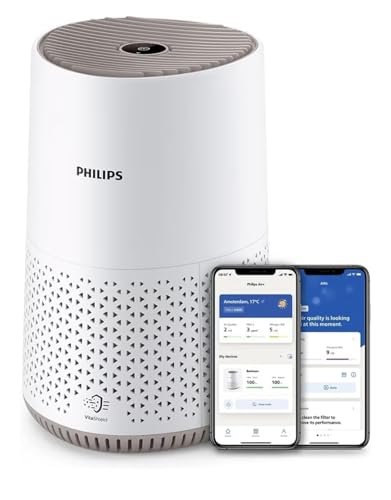
This air purifier/10 Smart 600i has a compact, slim housing designed to fit into smaller spaces, with dimensions of 24.3 x 23.7 x 34.1 cm (D x W x H) and a weight of 2.2 kg. In this review, the build appears straightforward and sturdy, with a white finish intended to suit most rooms. The digital display includes a dimmable light, which helps during bedtime. Setup is simple, and the light footprint makes it easier to place on shelves or floors. The narrow body may, however, limit desk-height placement options in tighter layouts.
Philips Air Purifier 900 Series
A compact, rectangular air purifier, this air purifier/13 is built to fit typical UK rooms without taking up much floor space, measuring 24D x 23.8W x 36.4H cm and weighing 3.5 kg. Its black casing looks simple and modern and is designed to sit stably on the floor or near furniture. The unit includes a digital display with a sleep mode option to dim the lights, reducing light disturbance. Build quality feels solid for day-to-day use. Overall, the design suits most households, with few compromises noted for the Philips.
CADR and Room Coverage
Philips Air Purifier Smart 600i Series
CADR and room coverage are central to how well the Philips/10 Smart 600i can clean a space. It is rated for rooms up to 44 m² with a CADR of 170 m³/h. That CADR indicates the purifier can exchange around 170 cubic metres of air each hour, which supports faster cleaning when pollutants are airborne. The 44 m² limit also signals weaker suitability for larger open-plan areas, where more units may be needed.
Philips Air Purifier 900 Series
CADR and room coverage matter because they show how quickly the air purifier can clean the air in a typical UK room once placed in position. The CADR is 250 m³/h, which supports coverage up to 65 m². The Philips also states it can purify 20 m² in less than 12 minutes, indicating solid cleaning speed for bedrooms, offices, or open-plan rooms. In spaces larger than the stated coverage, performance may take longer, so placement and unobstructed airflow become important.
HEPA Filtration Performance
Philips Air Purifier Smart 600i Series
Because this model is built around HEPA filtration, its performance depends on how effectively it traps fine airborne particles in everyday indoor air. The HEPA H13 filter is designed to remove PM2.5, pollen, dust, viruses and other contaminants. The air purifier states it can achieve 99.97% particle removal at 0.003 microns, targeting very small airborne matter. The unit also uses an electrostatic charge to attract particles, so filtration effectiveness depends on airflow through the purifier. Coverage is limited to up to 44 m², so larger spaces may require additional support.
Philips Air Purifier 900 Series
With HEPA filtration, the key question is how effectively the air purifier captures fine particles as air passes through the filter. The air purifier review describes it as a 3-layer HEPA system. The manufacturer states it captures 99.97% of particles down to 0.003 microns, targeting pollen, dust, dust mites and pet dander. Air moves through the multi-layer system, and smaller particles are trapped as they circulate. The manufacturer also claims removal of 99.9% of airborne viruses and bacteria, plus 99.99% of common allergens, with ECARF certification. Actual results depend on room airflow and particle levels.
Noise Level and Sleep Mode
Philips Air Purifier Smart 600i Series
Noise often determines whether an air purifier is run throughout the day and night, so it is worth considering how the Philips/10 performs in quiet use. In sleep mode, the air purifier runs at 19 dB(A), described as quieter than a whisper. This level suits bedroom use at night, with the digital display light dimmed. For everyday operation, noise can increase when the fan speed rises, which is noted as a trade-off for the Philips AC0650.
Philips Air Purifier 900 Series
The Philips AC0951/13 is designed to keep noise levels low, and its sleep mode targets bedrooms and other quiet rooms. In normal use, it operates quietly, with the clearest noise figure shown at 20.5 dB(A), which the sleep mode matches to help keep background sound minimal. Sleep mode also dims the display light, reducing the chance of bright LEDs disturbing sleep. For the Philips, the main advantage is low-noise operation. The limitation is that the unit still consumes power while it purifies in sleep mode.
Smart Features and App Control
Philips Air Purifier Smart 600i Series
The Philips/10 Smart 600i series can be controlled via the air purifier+ app, which supports on-the-go use from another room. The app allows users to switch the purifier on or off, adjust fan speed settings, and access in-app articles about air purification. It also provides monitoring, including filter status, to help users plan maintenance based on the device's prompts. For buyers comparing options, the Philips listing on Amazon UK highlights this connected control. A minor downside is that the smart functions rely on access to the app.
Philips Air Purifier 900 Series
Because it supports smart home use through the Air+ app, the air purifier/13 allows owners to manage the purifier remotely. The app enables adjustments while away and provides notifications when air quality is poor. In everyday use, the Air+ app delivers status alerts that help users respond quickly if pollution rises. The Philips listing on Amazon UK highlights this connected control as a practical fit for busy households. Smart features depend on app access and the initial setup may feel unfamiliar at first. Overall, the control options add convenience while keeping core cleaning performance unchanged.
Filter Life and Cost
Philips Air Purifier Smart 600i Series
Filter life and running cost depend on how often the purifier is used and how much pollution is removed while it operates at different fan speeds. For the air purifier, the app can monitor filter status, helping decide when replacement is actually needed. Running the purifier more often typically increases filter wear, so costs rise, particularly when higher fan speeds are used to clean a room quickly (CADR 170 m³/h, 44 m²). This air purifier price is therefore only one part of the total cost.
Philips Air Purifier 900 Series
Filter life and replacement planning matter because the air purifier/13 uses a smart filter change indicator to help prevent running with an overdue filter. The manufacturer says original filters can deliver performance for up to 1 year, and the purifier calculates filter life then alerts when replacement is due. For practical budgeting, buyers should check this air purifier price, as costs are often linked to ongoing filter purchases. The compatible replacement filter is FY0910, so availability can affect replacement timing. Some households may replace sooner if cigarette smoke or VOCs are heavy.
Energy Use
Philips Air Purifier Smart 600i Series
Energy use for the Philips is designed to keep power draw low, with a maximum consumption of 12 watts while cleaning the air. This means day-to-day electricity use depends on how many hours the purifier runs and which fan speed is used. Energy efficiency is supported by Energy Star certification, though the actual running cost is not provided.
Philips Air Purifier 900 Series
Energy use is a key budgeting factor once ongoing power costs are considered, particularly where the air purifier is used daily. For the Philips, the manufacturer states 21W at maximum power (also described as 23W for low energy use). Electricity costs can be estimated by using the electricity price per kWh, multiplying the stated power draw (21 to 23W) by the number of hours used, and then dividing by 1,000. Sleep mode noise is listed as 20.5 dB(A).
Cleaning and Maintenance
Philips Air Purifier Smart 600i Series
Cleaning and maintenance are straightforward, but they depend on how often the purifier runs and what pollutants are present in the room. In the Philips AC0650 purifier review of the AC0650/10, upkeep mainly involves checking the filter status in the air purifier+ app, then replacing the HEPA H13 filter when the app indicates. Before cleaning, the unit should be unplugged and the exterior wiped with a soft, dry cloth, and the vents should be kept clear. Since it is designed to target particles such as PM2.5, pollen, and dust, environments with heavier indoor pollution may require more frequent attention.
Philips Air Purifier 900 Series
Regular upkeep helps the Philips AC0951/13 maintain its stated performance, particularly in homes affected by dust, pet dander, pollen or odours. Owners should check the pre-filter area if it is visible, wipe the outer casing using a dry, soft cloth and keep the vents clear. The display can stay dim in sleep mode, but filter care matters more than light settings. The unit uses a smart change indicator, so the compatible filter FY0910 should be replaced when the indicator alerts.
Who Is This Air Purifier For?
Philips Air Purifier Smart 600i Series
This air purifier/10 Smart 600i air purifier suits people who want cleaner indoor air in smaller rooms, as it is rated to thoroughly clean areas up to 44 m² with a CADR of 170 m³/h. It is designed for everyday airborne particles, including PM2.5, pollen, dust, viruses and other pollutants. Its compact, slim design targets individual rooms rather than whole homes, making it a fit for households that do not need a larger-capacity unit. It also suits users who prefer app control via The Philips+ and quieter sleep-mode operation at 19 dB(A).
Philips Air Purifier 900 Series
The air purifier/13 is a strong match for households that want broad-room cleaning, particularly where dust, pollen, pet dander, odours, or smoke are common, because it is rated to cover up to 65 m² with CADR 250 m³/h and can purify 20 m² in less than 12 minutes. It suits allergy-prone people as it is Certified HEPA and removes 99.99% of pollen, dust mite, or pet allergens (ECARF). It also fits families wanting smart, app-based monitoring and those sensitive to noise, because sleep mode runs at 20.5 dB(A). For smaller rooms, coverage may be more than needed.
Philips Air Purifier Smart 600i Series: pros
- Strong airflow - CADR of 170 m³/h for rooms up to 44 m²
- HEPA filtration
- Quiet operation (19 dB(A))
- Smart-home and app control (Smart Home Compatible)
- Independently certified (Energy Star)
Cons
- Filter replacement intervals not stated by the manufacturer
Philips Air Purifier 900 Series: pros
- Strong airflow - CADR of 250 m³/h for rooms up to 65 m²
- HEPA filtration capturing 99.97% down to 0.003 microns
- Quiet operation (20.5 dB)
- Smart-home and app control (Smart Home Compatible)
- Independently certified (HEPA)
Cons
- Filter replacement intervals not stated by the manufacturer
Our verdict
Our pick is the Philips Air Purifier Smart 600i Series (our score 8.0/10) - A capable multi-stage air purifier with a CADR of 170 m³/h, held back mainly by a few practical limitations. The Philips Air Purifier 900 Series is still worth it if it is cheaper when you check, or if it better matches your specific needs.